NBA Playoffs

Golden State Warriors: 3 Things Stephen Curry Can Improve On Next Season

This article was originally published on Golden Gate Sports.

Mar 11, 2013; Oakland, CA, USA; Golden State Warriors point guard Stephen Curry (30) celebrates after scoring a basket against the New York Knicks during the second quarter at Oracle Arena. Mandatory Credit: Kelley L Cox-USA TODAY Sports

Stephen Curry had a breakout season this past year for the Golden State Warriors. In the regular season, Curry averaged 22.9 points (seventh in the NBA), 6.9 assists, four rebounds, and 1.6 steals on 45.1 percent shooting, 45.3 percent shooting from the three-point line (third in the NBA), and 90 percent free-throw shooting (second in the NBA). In the postseason, Curry averaged 23.4 points (sixth in the NBA), 8.1 assists (second in the NBA), 3.8 rebounds, and 1.7 steals on 43.4 percent shooting, 39.6 percent shooting from the three-point line, and 92.1 percent free-throw shooting.

Although Curry wasn’t selected to the 2012-2013 Western Conference All-Star Team, he played at an all-star calibur level throughout the entire season. What’s even more impressive is that he was coming off of two ankle surgeries on his right ankle in the past two offseasons. The Warriors organization and its fans had no idea how many games he would be able to play after playing only 26 games and being shut down due to his right ankle injuries in the shortened 2011-2012 season (only 66 total games instead of 82 games). Curry was able to play 78 games during the regular season and 90 games total, including the postseason, which is astonishing given the amount of ankle sprains he’s had.

Curry is considered a superstar and one of the best point guards in the NBA by many people, but every superstar can improve their game in some way or another. With Monta Ellis not on the team anymore, Curry knew he had to become more of a leader and become more of a vocal presence on the team this past season, which he certainly did.

Here are three things Curry can improve on next season:

Golden State Warriors: Should They Re-Sign Jarrett Jack or Carl Landry?

This article was originally published on Golden Gate Sports.

Apr 20, 2013; Denver, CO, USA; Golden State Warriors guard Jarrett Jack (2) warms up before game one of the first round of the 2013 NBA Playoffs against the Denver Nuggets at the Pepsi Center. Mandatory Credit: Chris Humphreys-USA TODAY Sports

The Golden State Warriors have some big decisions to make this offseason. They will have to assess if they can keep both of their key free agents, Jarrett Jack and Carl Landry, and, if they can’t afford to keep both, they need to decide which player of the two they should sign. Jack and Landry have both expressed that they want to come back to the Warriors. They will each have to discuss all possible situations though with their families and agents.

Jack averaged 12.9 points and 5.6 assists in 79 games this season, and he also finished third in the NBA’s Sixth Man of the Year Award voting. Jack made a little more than $5 million this season, but his level of play might have increased his value in free agency. He will certainly be a highly sought-after free agent, but he has expressed that he’d love to come back to the Warriors. However, Jack might be searching for a long-term deal, which the Warriors might not want to or be able to offer him.

Jack has been quite the journeyman around the league in his career so far. In his eight NBA seasons, he has played for five different teams. Curry has said that his biggest selling point to Jack to re-sign has been that Jack has found a home with the Warriors, and he could settle in here where he already knows what his role will be.

“As soon as I walked in the locker room, I looked down at my jersey and there just is a sense of pride that I have wearing it that I haven’t had as a professional,” Jack said. “Most of the time in college you go somewhere because you love it and there’s a connection there that’s deeper than basketball.

“I guess in the NBA since it’s such a business you usually don’t get that unless you’re one of those guys, one of the lucky few, that get to stay with one franchise for a long period of time.”

Landry averaged 10.8 points and six rebounds in 81 games this season, and he finished as the Warriors’ fifth-leading scorer and third-leading rebounder. Landry made $4 million this season, and he has a player option for next season for $4 million. It’s not clear if Landry will take that player option though, because it depends on what other offers he receives from other teams. Landry, like Jack, said he’d like to come back to the Warriors, but he also wants to keep his options open as he might also be offered a longer-term deal.

“Right now, I’m just going to try and clear my head and not worry about what’s ahead of me,” Landry said.“Sit down with the coaches and my mom, my family and my agent and see what’s the best for me in the future.”

Feb 22, 2013; Oakland, CA, USA; Golden State Warriors power forward Carl Landry (7) questions the call against the San Antonio Spurs during the third quarter at Oracle Arena. The Golden State Warriors defeats the San Antonio Spurs 107-101 in overtime. Mandatory Credit: Kelley L Cox-USA TODAY Sports

Warriors general manager Bob Myers has said that he is willing to go into the luxury tax in order to acquire the right players. Last offseason, Myers and the rest of the Warriors’ front office wanted to acquire Landry and re-sign Brandon Rush, and, in order to do that, the team would have to go into the luxury tax without knowing if they’d be able to get out of it.

According to Myers, the ownership group, Joe Lacob and Peter Guber, told them to spend whatever they needed to if they thought Landry and Rush were important to the team. Myers will continue this philosophy when entering into discussions with Jack and Landry.

“That’s a blessing to be able to work in an organization like that where it’s not budget, it’s not cost, it’s not dollars, it’s winning,” Myers said.

Several players on the Warriors have also shown that they want both Landry and Jack to re-sign.

“I want them back,” Stephen Curry said. “They’re great teammates. They’ve added a lot to us as a team and what we’re trying to do.”

Andrew Bogut has expressed the same desire. However, he realizes that it might be a difficult task to bring back both.

“In an ideal world, it’s very important (to bring them back), but being a realist we probably can’t keep both of them,” Bogut said. “I don’t think we’ll have cap room to keep both, even though we’d like to. They’re going to both demand some pretty good money.”

So if the Warriors decide they aren’t fiscally able to re-sign both Jack and Landry, who should they aim to re-sign? Who will be more valuable to the Warriors next season? Both players were important to the Warriors and their playoff run, so which one would be easier to replace in free agency then?

Some point guards who are going to be free agents and would most likely be in the Warriors’ desired price range are Will Bynum, D.J. Augustin, Earl Watson, Jerryd Bayless (who has a player option with the Grizzlies for next season though), Jamaal Tinsley, Sebastian Telfair, etc. None of these players would adequately fill the role that Jack had, and wouldn’t make up for his scoring, passing and leadership.

Some power forwards who are going to be free agents and would most likely be in the Warriors’ desired price range are Elton Brand, Andray Blatche, Jason Maxiell, Antawn Jamison, DeJuan Blair, Jermaine O’Neal, J.J. Hickson, etc.

May 16, 2013; Oakland, CA, USA; Golden State Warriors point guard Jarrett Jack (2) passes out the ball between San Antonio Spurs point guard Gary Neal (14) and center Boris Diaw (33) during the first quarter of game six of the second round of the 2013 NBA Playoffs at Oracle Arena. Mandatory Credit: Kelley L Cox-USA TODAY Sports

Obviously, it’s not guaranteed that the Warriors could persuade any of these players to win, but their playoff run could certainly help attract some of them. This group of power forward free agents seems stronger than the group of available point guards. Because of this, if the Warriors could only afford to re-sign either Jack or Landry, it seems as if the Warriors should aim to re-sign Jack. Of course, the Warriors have the option of acquiring a point guard or power forward via trade, but regardless of the potential trades, Jack had a strong leadership role and presence on this team.

Although it would be ideal to bring Landry back too, it seems as if there are better options to replace Landry, which makes Jack more valuable to the Warriors next season.

Golden State Warriors: How Fatigue Limited Stephen Curry in the Playoffs

This article was originally published on Golden Gate Sports.

May 2, 2013; Oakland, CA, USA; Golden State Warriors point guard Stephen Curry (30) looks on against the Denver Nuggets during the fourth quarter of game six of the first round of the 2013 NBA Playoffs at Oracle Arena. The Warriors defeated the Nuggets 92-88. Mandatory Credit: Kyle Terada-USA TODAY Sports

Stephen Curry was expected to play a lot of minutes this season, especially with his ankle problems mostly behind him and Monta Ellis no longer on the Warriors. In fact, Curry averaged a career-high 38.2 minutes per game in 78 games during the regular season, which was the seventh most minutes per game in the NBA. Curry is the most the important player on this Warriors team, but given the fact that he had two ankle surgeries in the past two offseasons going into the 2012-2013 season, Mark Jackson probably should have monitored his minutes a little more in the regular season.

The Warriors have a fairly strong bench, which includes Jarrett Jack, Carl Landry, Draymond Green, and Festus Ezeli. However, there were several times during the course of the regular season where the second unit would come in and struggle offensively. Because of this, Curry had to come back into the game earlier than expected in order to provide an offensive lift. Because of this, Curry had to play a lot of minutes this season, even sometimes in games where he shouldn’t have had to play so many. Curry was relied upon too much for his offense in the regular season, and Mark Jackson didn’t seem to manage his minutes in preparation for the postseason.

It appeared as if the abundance of minutes that Curry played during the regular season caught up with him in the playoffs. With David Lee out, he was expected to take on an even bigger load of minutes as well. He clearly seemed exhausted at times during the Spurs series. It’s also possible that his exhaustion was the reason why he tweaked his ankle again. His body was tired and had been beaten up throughout the playoffs, which could’ve caused his body to be more susceptible to injury, or, in this case, re-injury. Regardless of if that was the sole reason why he hurt his ankle again, Curry ran out of gas during the Spurs series due to his heavy load of minutes in 94 games this season.

In the Warriors’ series against the Spurs, Curry seemed a step slow at certain times. He wasn’t quite 100 percent after spraining his left ankle in Game 2 of the Denver series, but his slow pace seemed more like fatigue than the result of a bum ankle. In the postseason, Curry averaged 41.4 minutes per game in 12 games, which was the sixth most minutes per game in the NBA. In addition, he played a total of 497 minutes in 12 games, which, as of today, was the most minutes in the NBA in the postseason.

After playing every single minute (except for four seconds) of the Warriors’ Game 1 double overtime loss to the Spurs, Curry looked exhausted at several points during the rest of the series. He tweaked his left ankle again in Game 3, which the Warriors eventually lost. He played through the pain in Game 3 and had a bad limp the rest of the game. It didn’t seem like Curry would be able to play in Game 4, but he took a pain injection shot so he could play. He didn’t look as quick, but he was able to help the Warriors get the win. In Game 5, Curry’s ankle didn’t seem to be bothering him as much, but he looked flat-out exhausted.

“Curry missed several shots coming off the pick, and whether he couldn’t get the lift off the ankle, didn’t have the energy to execute, or was rushed by the way the Spurs were scrambling against and over screens, it worked,” NBA writer Matt Moore said of Curry’s performance in Game 5.

During the course of the season, Curry was called upon to make plays and play extra minutes when the Warriors struggled offensively. Jackson might have relied on him too much though, because Curry’s heavy load of minutes throughout the regular season and the playoffs potentially caused him to re-injure himself, and it caused him to perform poorly at times. He was simply exhausted. Curry is arguably a superstar in the NBA, so he will be relied upon even more in the future. Hopefully for the Warriors, Jackson will find a more efficient way to manage Curry’s minutes next season.

GSW: NBA Playoffs: The Importance Of Andrew Bogut To The Golden State Warriors

May 14, 2013; San Antonio, TX, USA; Golden State Warriors center Andrew Bogut (12) and San Antonio Spurs forward Tim Duncan (behind) battle for position during the second half in game five of the second round of the 2013 NBA Playoffs at the AT&T Center. Mandatory Credit: Soobum Im-USA TODAY Sports

May 14, 2013; San Antonio, TX, USA; Golden State Warriors center Andrew Bogut (12) and San Antonio Spurs forward Tim Duncan (behind) battle for position during the second half in game five of the second round of the 2013 NBA Playoffs at the AT&T Center. Mandatory Credit: Soobum Im-USA TODAY Sports

Stephen Curry and Klay Thompson have had some spectacular performances for the Warriors so far in the playoffs. Jarrett Jack and Harrison Barnes have also had significant contributions. However, Andrew Bogut has been one of the most important players for the Warriors in the playoffs. He isn’t one of the Warriors’ leading scorers, but his defense, his physicality, and his energy are significant reasons why the Warriors have gotten as far as they have in the playoffs.

Click here to read the rest of the story at Golden Gate Sports.

GSW/SFG: Golden State Warriors and San Francisco Giants Share the Same Winning Formula

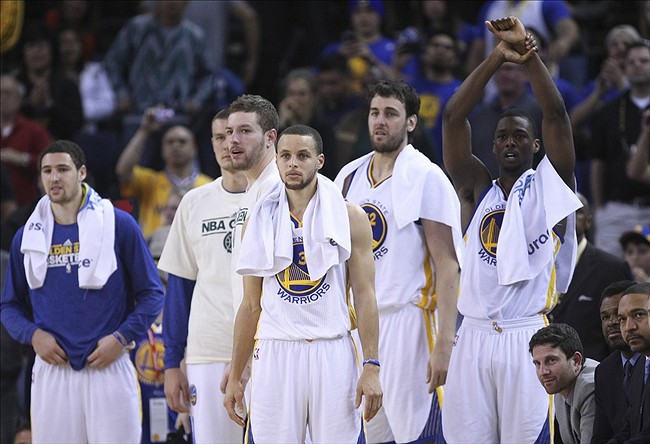
April 09, 2013; Oakland, CA, USA; Golden State Warriors bench of starters stand up for the final seconds of the game against the Minnesota Timberwolves during the fourth quarter at Oracle Arena. The Golden State Warriors defeated the Minnesota Timberwolves 105-89 to clinch a playoff berth. Mandatory Credit: Kelley L Cox-USA TODAY Sports

April 09, 2013; Oakland, CA, USA; Golden State Warriors bench of starters stand up for the final seconds of the game against the Minnesota Timberwolves during the fourth quarter at Oracle Arena. The Golden State Warriors defeated the Minnesota Timberwolves 105-89 to clinch a playoff berth. Mandatory Credit: Kelley L Cox-USA TODAY Sports

The Golden State Warriors and the San Francisco Giants are both successful teams with similar winning formulas. Although the Warriors haven’t won two championships in the past three seasons, both of these teams are built on similar principles. Both teams have a good balance between homegrown talent and players that have come via trade or free agency, both teams showcase a few star players, but they both play like a team, and both teams have excellent team chemistry, stellar defense (or pitching, in the case of the Giants), and an underdog mentality.

Click here to read the rest of the story at Golden Gate Sports.

GSW: NBA Playoffs: The Golden State Warriors Are Showing Their Toughness

May 2, 2013; Oakland, CA, USA; Golden State Warriors point guard Stephen Curry (30) celebrates against the Denver Nuggets during the third quarter of game six of the first round of the 2013 NBA Playoffs at Oracle Arena. The Warriors defeated the Nuggets 92-88. Mandatory Credit: Kyle Terada-USA TODAY Sports

May 2, 2013; Oakland, CA, USA; Golden State Warriors point guard Stephen Curry (30) celebrates against the Denver Nuggets during the third quarter of game six of the first round of the 2013 NBA Playoffs at Oracle Arena. The Warriors defeated the Nuggets 92-88. Mandatory Credit: Kyle Terada-USA TODAY Sports

In the 2013 NBA Playoffs, much of the discussion about the Golden State Warriors has been about their youth, their inexperience, their three-point shooting, and Stephen Curry’s rise to stardom. One aspect of the Warriors’ identity that hasn’t been discussed nearly enough though is their toughness.

Click here to read the rest of the story at Golden Gate Sports.